
What Is Ear Acupuncture and What Is It Used For?
Ear acupuncture, also called auricular acupuncture, involves inserting fine, sterile needles into specific points on the outer ear. It is used as a complementary therapy for relaxation and to support symptom management alongside conventional care. People commonly seek it for stress, sleep difficulties and emotional wellbeing, although evidence of benefit varies by condition.
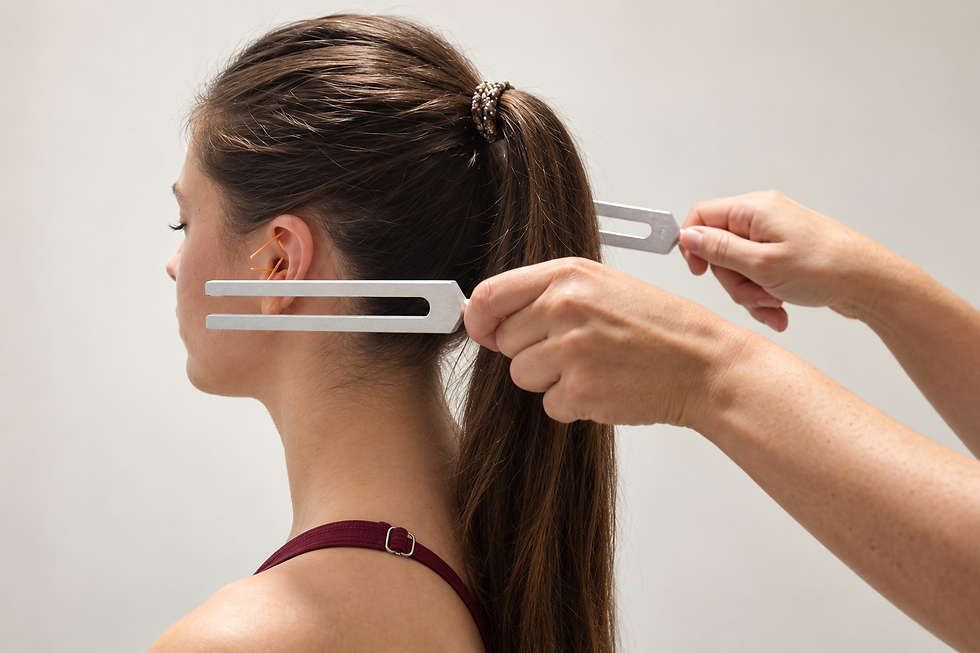
At SmartHealth Clinic in Nottingham, we love ear acupuncture and offer it as part of our sessions. For instance, our AcuSound Ear Acupuncture & Tuning Forks session combines five-point ear acupuncture with therapeutic sound and gentle vibration.

What is ear acupuncture used for?
Ear acupuncture is used to support physical comfort and emotional wellbeing, with applications ranging from pain management to relaxation and stress support.
Common uses include:
Pain management, including back pain, neck pain and other muscle or joint discomfort. A clinical trial found greater pain relief within an hour when a specific ear acupuncture protocol was added to usual care for acute musculoskeletal pain . Read the PubMed study
Headache and migraine support, although research on ear acupuncture is still limited .Read the research on PubMed
Relaxation, stress management and support for sleep difficulties, providing time to rest and unwind.
Symptom support during cancer care, including hot flushes, nausea, fatigue and pain, alongside medical treatment. York and Scarborough Teaching Hospitals
The points and techniques used depend on the purpose of treatment. Pain-focused ear acupuncture protocols can differ from the five-point approach used for relaxation and wellbeing. Results vary, and short-term relief does not necessarily resolve the underlying cause of a symptom.
Ear acupuncture is intended to complement medical care, not replace diagnosis, prescribed medication or psychological support.
How does ear acupuncture work?
Ear acupuncture is based on the concept that the outer ear represents a miniature map of the body, with particular areas associated with different body parts. Practitioners use this map to guide their selection of treatment points.
The ear map is often illustrated as an upside-down baby, with the head represented near the earlobe and other body regions arranged around the ear. This model is used in auricular therapy; it does not mean each point has a scientifically proven connection to a particular organ. Background on auricular mapping

You may recognise a similar idea from foot and hand reflexology, where areas of the feet and palms are believed to correspond to other parts of the body. These are separate treatment systems, and their proposed point-to-organ relationships have not been scientifically established.
From a scientific perspective, acupuncture may influence nervous system activity and the way the body processes pain. However, the precise mechanisms remain incompletely understood, particularly for specific ear acupuncture techniques. Possible effects on nerve signalling should not be taken as proof of the body map or a guaranteed ability to “rebalance” the nervous system. NCCIH: Acupuncture
What happens during an ear acupuncture session?
Your appointment begins with a discussion about your health, medication and reasons for seeking treatment.
During a typical five-point ear acupuncture session:
You sit or recline comfortably.
Fine, sterile, single-use needles are placed into selected points on the outer ears.
You rest quietly with the needles in place, commonly for around 30 minutes.
Your practitioner removes and safely disposes of the needles.
The number of needles and treatment length can vary depending on the approach used.
Does ear acupuncture hurt?
You may feel a brief prick or tenderness as the needles are inserted. Sensations vary, and treatment should not involve ongoing discomfort. Let your practitioner know if a needle feels painful.
Possible temporary side effects include local tenderness, minor bleeding and dizziness. Fainting can occasionally occur.
What is the difference between ear acupuncture and ear seeds?
Ear acupuncture uses needles; ear seeds apply pressure without piercing the skin. Ear seeds are small seeds or beads attached to the outer ear with adhesive tape. They are a form of acupressure, and a practitioner should discuss suitability and aftercare.
Who can have ear acupuncture?
Suitability depends on your health and individual circumstances. Tell your practitioner if you are pregnant, take blood-thinning medication, have a bleeding disorder or have an infection near the treatment area. If you are receiving cancer treatment, discuss acupuncture with your treatment team beforehand.
AcuSound ear acupuncture in Beeston, Nottingham
At SmartHealth Clinic, our AcuSound Ear Acupuncture & Tuning Forks treatment combines five-point ear acupuncture with selected tuning forks, therapeutic sound and gentle vibration.
Sessions provide a quiet setting where you can step away from daily demands and take time to rest. We discuss your needs before treatment and explain each part of the session.
Our clinic is located at 40 Wollaton Road, Beeston, Nottingham, NG9 2NR.
Interested in trying ear acupuncture? Contact SmartHealth Clinic to learn more about AcuSound and discuss whether it is suitable for you.
Sources and further reading
National Center for Complementary and Integrative Health (NCCIH). Acupuncture: Effectiveness and Safety.
National Center for Complementary and Integrative Health (NCCIH). Reflexology.
Guy’s and St Thomas’ NHS Foundation Trust. Acupuncture community clinic: Ear acupuncture sessions.
York and Scarborough Teaching Hospitals NHS Foundation Trust. (2024). Auricular Acupuncture: Information for Patients.
Wrightington, Wigan and Leigh Teaching Hospitals NHS Foundation Trust. (2026). Auricular Acupuncture at Cancer Care Suite.
Cancer Research UK. Acupuncture.
Eucker, S. A., et al. (2024). An adaptive pragmatic randomized controlled trial of emergency department acupuncture for acute musculoskeletal pain management. Annals of Emergency Medicine, 84(4), 337–350.
Michel-Cherqui, M., et al. (2023). Auriculotherapy in prevention of migraine attacks: An open randomized trial. Frontiers in Neurology, 14, 1193752.

![Ear Acupuncture (Auriculotherapy)]](https://static.wixstatic.com/media/4eabbc_ddd602cc9e834ed3bc2e584439c2c498~mv2.png/v1/fill/w_980,h_1389,al_c,q_90,usm_0.66_1.00_0.01,enc_avif,quality_auto/4eabbc_ddd602cc9e834ed3bc2e584439c2c498~mv2.png)
Comments